

polars-umap
UMAP dimensionality reduction as a Polars plugin, powered by Apple's embedding-atlas Rust implementation
UMAP dimensionality reduction as a Polars plugin.
import polars as pl
import polars_umap  # registers the `umap` namespace

df.with_columns(xy=pl.col("embedding").umap.fit_transform(metric="cosine"))
polars-umap runs UMAP (Uniform Manifold Approximation and Projection) directly inside Polars expressions. It is powered by the Rust ports of umap-learn and PyNNDescent from Apple’s embedding-atlas.
- Native Polars: works on
Array/Listembedding columns or plain numeric columns, in eager and lazy mode, and per group with.over()orgroup_by().agg(). - Fast: 2–12× faster than umap-learn, with no JIT warm-up and optional GPU acceleration.
- Faithful: reproduces the umap-learn 0.6 pipeline by default, or the classic 0.5 pipeline. Embedding quality matches umap-learn.
- Reproducible: with a
random_state, results are bit-identical regardless of the number of threads. - Small footprint: one wheel that depends only on Polars. Supports Python ≥ 3.9 and Polars ≥ 1.0.
Documentation: https://polars-umap.jeroenjanssens.com/
Installation
uv add polars-umap
# or
pip install polars-umap
Quickstart
import polars as pl
import polars_umap as pu
from sklearn.datasets import load_digits

X, y = load_digits(return_X_y=True)
df = pl.DataFrame({"pixels": X, "digit": y})  # pixels: Array(Float64, 64)

# Expression API: returns an Array(Float32, 2) column
df.with_columns(xy=pl.col("pixels").umap.fit_transform(random_state=42))

# DataFrame API: adds umap_0 and umap_1 columns
df.umap.fit_transform("pixels", random_state=42)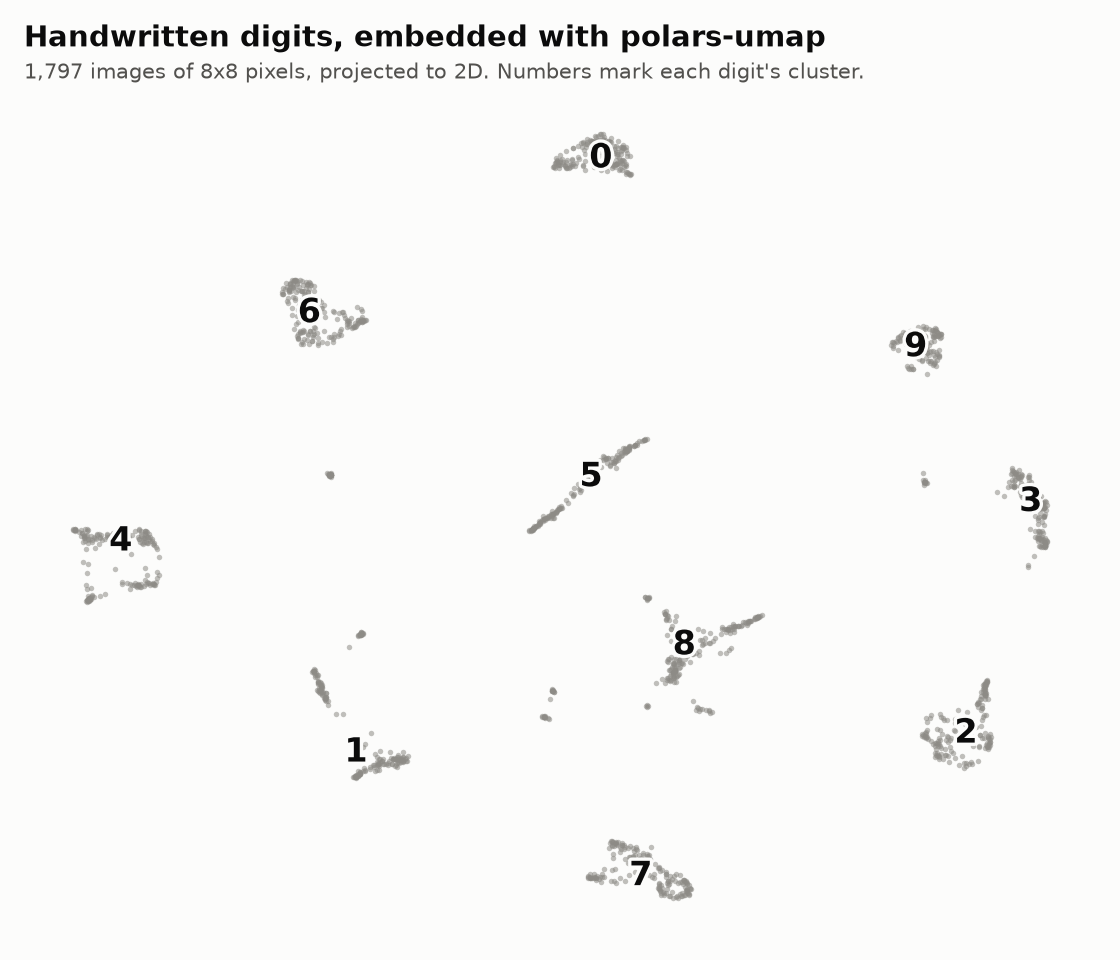
A taste of the API
# Several numeric columns, stacked into a feature matrix (selectors work too)
pu.umap("sepal_length", "sepal_width", "petal_length", "petal_width")

# One UMAP per group, in a single query
pl.col("embedding").umap.fit_transform(random_state=0).over("category")

# Fit on the valid rows, return null for rows with null/NaN values
pl.col("embedding").umap.fit_transform(null_policy="ignore")

# Approximate nearest neighbors, and UMAP on a precomputed graph
pl.col("embedding").umap.knn(k=15, metric="cosine")
pu.umap_from_knn("indices", "distances")
The user guide covers these in depth, along with choosing parameters, reproducibility and performance. The examples include a Quarto report and an interactive marimo notebook.
Benchmarks
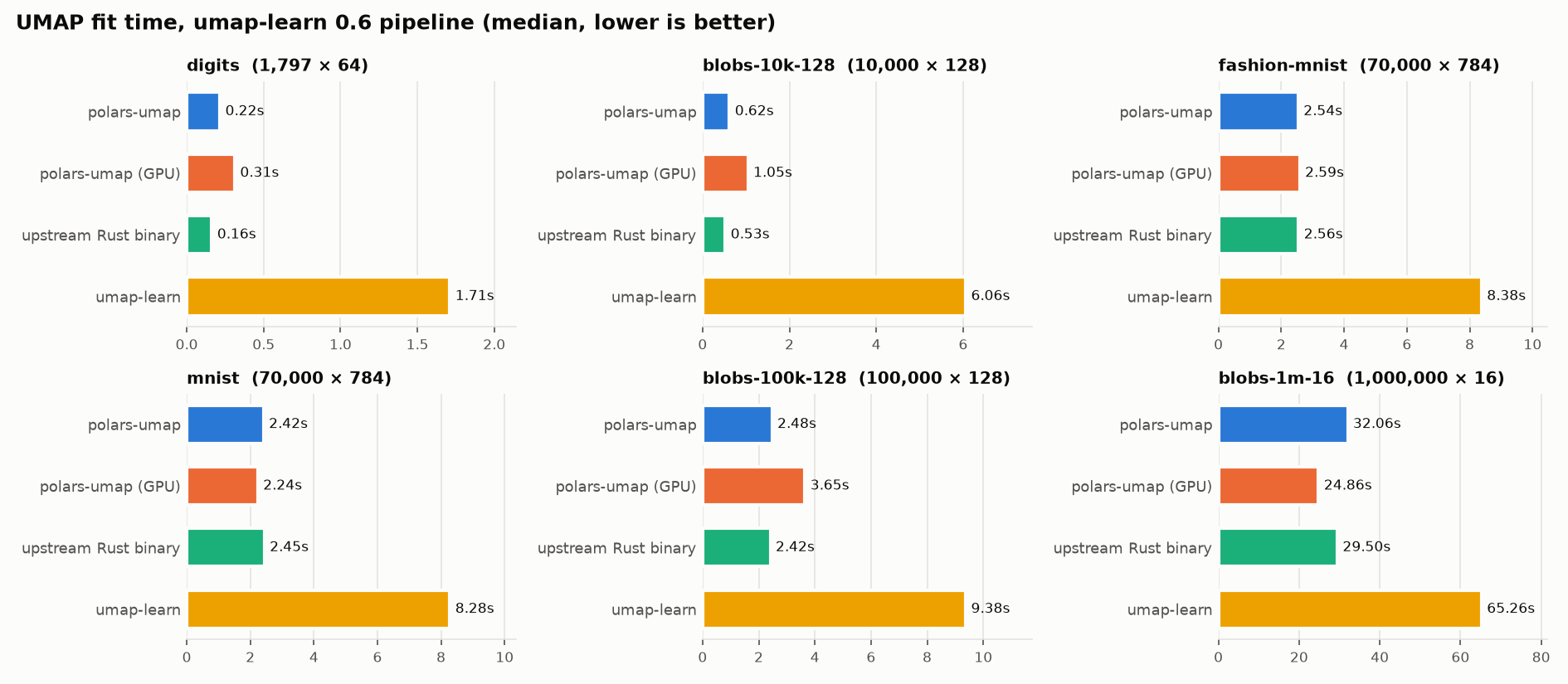
- 2–12× faster than umap-learn, with the same trustworthiness, kNN recall and label accuracy. This excludes umap-learn’s 10–12 s numba warm-up.
- No measurable overhead from Polars: polars-umap is as fast as the raw upstream Rust binary.
.over()with 1,000 groups: 18 s, against 58 s for a Python loop.
See the benchmarks page for all results and the methodology.
Limitations
The upstream implementation only fits, so there is no transform() for new points. Supervised UMAP, densMAP and sparse input aren’t supported either.
Contributing
See CONTRIBUTING.md for how to build, test and benchmark polars-umap, and how to build the documentation.
Acknowledgements
The algorithms are implemented by Apple’s embedding-atlas (MIT), which ports umap-learn and PyNNDescent by Leland McInnes. Please cite the UMAP paper if you use this in research:
McInnes, L., Healy, J., & Melville, J. (2018). UMAP: Uniform Manifold Approximation and Projection for Dimension Reduction. arXiv:1802.03426.